Computational Biotechnology: A New Frontier in Biopharmaceutical Research

Developing a new medicine is rarely a simple process. Researchers may spend years studying diseases, testing molecules, analyzing biological data, and refining potential treatments before a drug can reach patients. The challenge becomes even greater as scientists work with increasingly complex biological systems and enormous amounts of data.
This is where computational biotechnology is making a difference.
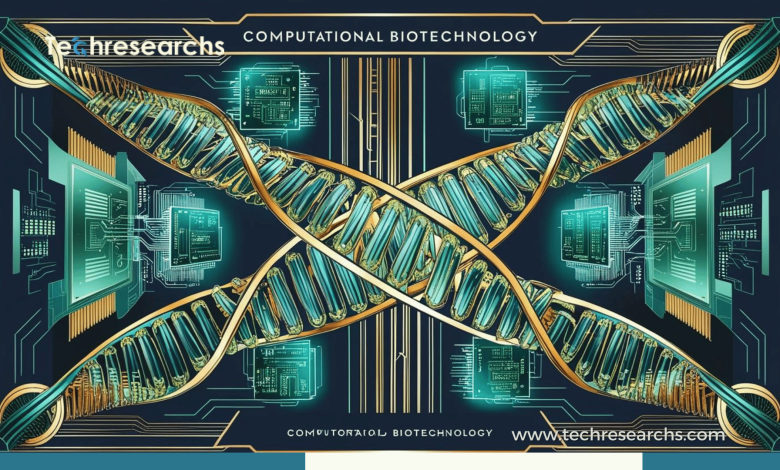
By combining biotechnology with artificial intelligence, machine learning, bioinformatics, data analysis, and computer modeling, researchers can investigate biological problems in ways that were difficult to achieve in the past. Instead of relying only on trial-and-error experiments, scientists can use computational tools to generate predictions, identify promising candidates, and decide which experiments are worth pursuing.
Computational biotechnology is not replacing the laboratory. Instead, it is becoming a powerful partner to experimental science.
What Is Computational Biotechnology?
Computational biotechnology is the use of computer-based techniques to understand biological systems and solve problems in biotechnology and medicine.
Modern biological research produces huge amounts of information. Genomic sequencing, protein analysis, medical research, molecular experiments, and clinical studies can all generate datasets that are difficult to analyze manually.
Computational tools help researchers turn this raw information into useful insights.
Depending on the research goal, computational biotechnology can be used to:
- Study genes and genetic variations
- Analyze proteins and their structures
- Identify potential drug targets
- Predict how molecules may interact
- Compare biological datasets
- Design or improve therapeutic proteins
- Study disease-related biological pathways
- Support personalized treatment research
The real value comes from connecting these capabilities with laboratory research. A computer can suggest what might work, but scientists still need to test whether those predictions hold true in the real world.
Why Is Computational Biotechnology Important for Biopharmaceutical Research?
The biopharmaceutical industry is dealing with a growing volume of biological information. At the same time, researchers are looking for better ways to develop treatments while controlling development time and costs.
Traditional research often requires scientists to test many possibilities before finding a promising candidate. Computational approaches can help narrow those possibilities earlier.
For example, instead of experimentally testing a very large collection of molecules, researchers can first use computational screening to identify candidates that appear more likely to interact with a particular biological target.
This does not guarantee success, but it can help researchers spend laboratory resources more strategically.
Accelerating the Drug Discovery Process
Drug discovery is one of the areas where computational biotechnology has attracted significant attention.
A typical drug development journey involves identifying a disease mechanism, finding a suitable target, discovering potential compounds, testing their activity, and gradually improving the most promising candidates.
Computational methods can contribute at several points in this process.
Identifying Potential Drug Targets
A disease can involve complicated interactions between genes, proteins, cells, and biological pathways. Researchers can use computational analysis to study these relationships and identify biological targets that may be relevant to a particular disease.
By analyzing large datasets, scientists can look for patterns that could be difficult to detect using individual experiments.
Screening Potential Molecules
Testing every possible compound in a laboratory would be extremely time-consuming.
Virtual screening provides another approach. Computer models can evaluate molecular properties and estimate which compounds could potentially interact with a selected target.
Researchers can then take a smaller group of candidates into laboratory testing.
Predicting Molecular Behavior
A promising drug candidate needs to do more than interact with a target. Scientists also need to understand properties such as stability, selectivity, and potential toxicity.
Computational models can provide early predictions that help researchers decide which candidates deserve further investigation.
Artificial Intelligence Is Changing the Way Researchers Work
Artificial intelligence has become an important part of computational biotechnology.
Machine learning systems can examine large datasets and identify relationships between biological features and outcomes. In pharmaceutical research, this can be useful for areas such as molecular prediction, biomarker discovery, drug-target analysis, and protein engineering.
AI can also assist with tasks that previously required extensive manual analysis.
However, it is important to keep expectations realistic. An AI model can produce a useful prediction, but a prediction is not the same as a confirmed biological result.
Researchers still need experiments to determine whether a computational result actually works under real biological conditions.
Protein Engineering Gets a Computational Boost
Proteins are central to many biological processes and are also important components of modern medicines.
Scientists may want to modify a protein so that it becomes more stable, more effective, or better suited to a particular therapeutic application. But proteins can contain hundreds or thousands of possible sequence variations, making experimental testing alone difficult.
Computational models can help researchers explore these possibilities.
A model might estimate how a particular change could influence protein stability or function. Scientists can then select the most promising variants for laboratory testing.
This approach can make protein engineering more focused and reduce the number of unnecessary experiments.
Supporting the Development of Biologics
Biopharmaceutical research is not limited to traditional small-molecule drugs. Modern medicine increasingly relies on biologics, including antibodies, therapeutic proteins, vaccines, and other advanced biological products.
These products can be complicated to design and manufacture.
Computational biotechnology can support their development by helping researchers analyze biological sequences, study molecular structures, predict interactions, and optimize candidate molecules.
For example, computational approaches can assist in antibody research by comparing sequences and identifying changes that could potentially improve desired characteristics.
Again, laboratory validation remains essential, but computational analysis can make the search process more efficient.
Computational Biotechnology and Personalized Medicine
Not every patient responds to a treatment in the same way.
Genetic differences, biological characteristics, and other patient-specific factors can influence how a therapy works. This has increased interest in personalized medicine, where treatments are developed or selected based on individual patient characteristics.
Computational biotechnology can help researchers analyze patient datasets and identify biological patterns associated with treatment response.
For example, computational analysis may help researchers investigate whether certain genetic or molecular characteristics are linked with better outcomes for a particular therapy.
As more biological and clinical data become available, computational tools could become increasingly important for developing more targeted treatments.
Improving Biopharmaceutical Manufacturing
Computational biotechnology also has applications after a promising treatment has been discovered.
Producing biological medicines consistently can be challenging. Living cells and biological systems can respond to changes in their environment, which means manufacturing conditions need to be carefully controlled.
Computational models can analyze production data and help researchers understand how different process variables affect results.
AI-based monitoring may also help identify unusual patterns before they become larger manufacturing problems.
This could contribute to more efficient production and improved process consistency.
The Benefits of Computational Biotechnology
The growing use of computational methods offers several potential advantages for biopharmaceutical research.
More Efficient Research
Researchers can analyze large numbers of possibilities computationally before selecting candidates for physical experiments.
Better Decision-Making
Predictions and data analysis can provide additional evidence when researchers decide which candidates or research directions deserve attention.
Reduced Experimental Work
Computational screening may reduce the number of candidates that need to be tested experimentally, particularly during early-stage research.
Better Understanding of Complex Biology
Computational analysis can reveal relationships between genes, proteins, molecules, and biological pathways that may be difficult to understand from isolated experiments.
Faster Iteration
Researchers can move more quickly between computational design and laboratory testing, creating a more efficient research cycle.
What Are the Challenges?
Despite its promise, computational biotechnology still faces important limitations.
Poor-Quality Data Can Produce Poor Results
AI and computational models depend on the information used to build and test them. If the underlying data are incomplete, inconsistent, or biased, the resulting predictions may also be unreliable.
Biology Is Difficult to Predict
Biological systems are highly interconnected. A change that appears beneficial in a computer model may produce an unexpected result in an actual biological system.
Predictions Need Validation
Computational results should be treated as research guidance rather than final proof. Laboratory experiments and clinical studies remain necessary for establishing safety and effectiveness.
Computational Skills Are in High Demand
Successful computational biotechnology projects require knowledge from multiple fields. Researchers increasingly need to understand both biological science and computational methods, creating a demand for interdisciplinary skills.
Data Security Matters
Biopharmaceutical research involves valuable research data, intellectual property, and sometimes sensitive patient information. Protecting these resources is an important part of responsible computational research.
What Does the Future Look Like?
The relationship between biology and computing is likely to become even stronger over the coming years.
One particularly interesting direction is the integration of AI-based design with automated laboratory systems. In such a workflow, computational models could suggest potential candidates, automated experiments could test them, and the results could be used to improve the next round of predictions.
This creates a continuous design, test, and learn cycle.
Researchers could potentially explore more possibilities in less time while using experimental resources more efficiently.
At the same time, advances in biological data generation will continue to provide computational scientists with new information to analyze. The combination of better datasets, improved algorithms, and stronger laboratory validation could open new opportunities in drug discovery and therapeutic development.
Conclusion
Computational biotechnology is changing how researchers approach some of the most difficult problems in biopharmaceutical science.
From identifying potential drug targets and screening molecules to engineering proteins, studying patient data, and improving manufacturing processes, computational tools can support research at many stages.
The biggest opportunity is not simply using artificial intelligence or computer models on their own. It is bringing computational predictions together with human scientific expertise and carefully designed experiments.
As this collaboration becomes more sophisticated, computational biotechnology could help make biopharmaceutical research more efficient, targeted, and innovative.
The laboratory will remain essential, but the future of biotechnology may increasingly depend on what scientists can discover when computational intelligence and biological experimentation work together.
Frequently Asked Questions
1. What is computational biotechnology?
Computational biotechnology combines biological science with computing, data analysis, artificial intelligence, and mathematical modeling to study biological systems and support biotechnology research.
2. How does computational biotechnology help drug discovery?
It can help researchers analyze biological data, identify potential drug targets, screen molecules virtually, and predict certain molecular properties before candidates move into laboratory testing.
3. Can computational biotechnology replace laboratory experiments?
No. Computational methods provide predictions and useful research insights, but laboratory experiments are still necessary to verify biological activity, safety, and effectiveness.
4. What is the future of computational biotechnology?
The field is expected to become increasingly connected with AI, automated laboratories, advanced biological datasets, and precision medicine, helping researchers explore and develop new therapies more efficiently.